
What a Small Business Plan Example Actually Is
A small business plan example is a sample document showing how a real business plan is structured, section by section. In South Africa, funders like SEFA, NYDA, commercial banks and private investors all expect the same core layout, whether your business operates from a township spaza shop, a salon in town or a construction site in another province.
You do not need a 50-page document. A small business plan for a one-person or few-person operation is usually 10 to 20 pages. What matters is that every section is complete and the numbers add up.
The Sections Every Example Contains
When you look at a proper small business plan example, you will see these sections in this order:
- Cover page with your business name, logo, contact details and date.
- Executive summary that explains your business in one page. Funders read this first. If it is weak, they stop.
- Business description covering what you sell, where you operate and what problem you solve.
- Market analysis showing who your customers are, who your competitors are and how you will reach those customers.
- Products or services with pricing and how you deliver them.
- Marketing plan explaining how you will get sales.
- Operational plan covering premises, equipment, suppliers and staff.
- Management and ownership with the names, ID numbers and roles of the owners. If you have a CIPC registration certificate, attach it.
- Financial plan with a startup cost breakdown, monthly cash flow forecast for 12 months, income statement and a note on how much funding you need and what you will use it for.
- Compliance details such as your CIPC registration number, SARS tax reference, B-BBEE certificate if you have one and any sector licence like a CIDB grading for construction or a health certificate for food.
Two Quick Examples
Here is what a small business plan example looks like for two common township and small-town businesses.
Example 1: Catering Business
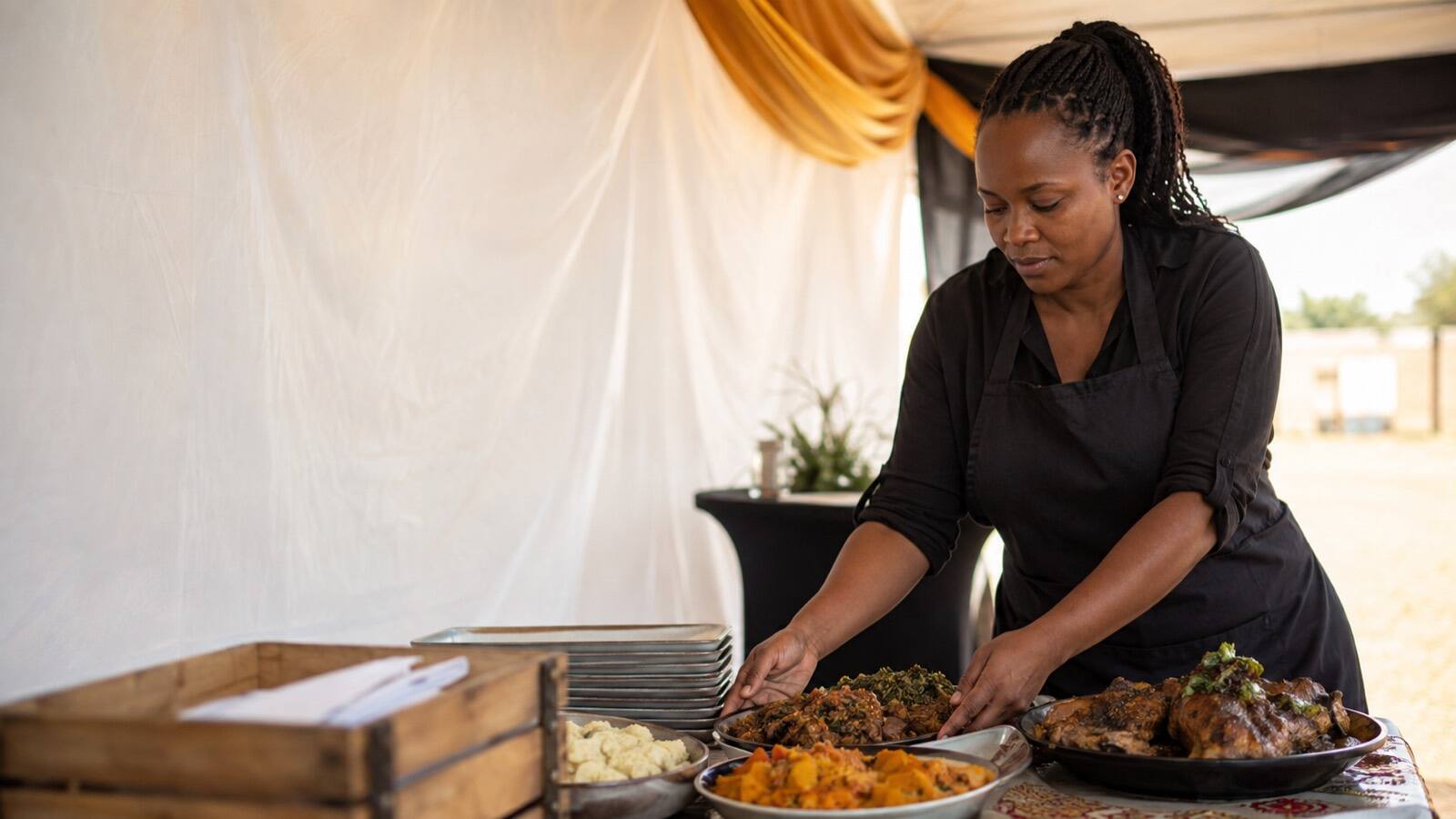
A catering business plan starts with the executive summary stating the business name, the owner, the location and the amount of funding needed. The market analysis names the target customers, which could be funerals, weddings, corporate events and government department functions. The operational plan lists the kitchen premises, the cooking equipment, the staff needed for preparation and serving and the supplier of ingredients. The financial plan shows the cost of pots, gas, uniforms and transport as startup costs, then projects monthly income based on the number of events booked.
For government catering tenders, the compliance section must show your CIPC registration, a SARS tax clearance status, a B-BBEE certificate or affidavit and a health certificate from your local municipality. Without these, your tender bid will be disqualified.
Example 2: Construction or Maintenance Business
A construction business plan example focuses heavily on the CIDB grading. If you want to tender for government contracts, you need a CIDB registration and the right grading for the value of work you want to bid for. The operational plan lists the tools, vehicles, site staff and subcontractors. The financial plan shows the cost of equipment, working capital for paying staff before the client pays you, and the expected profit margin per project.
Many construction business plans fail because the cash flow does not account for the delay between doing the work and receiving payment from the government client. A good example shows how you will survive that gap.
Where to Find Real Examples
You can find small business plan examples on the SEFA and SEDA websites, in the NYDA entrepreneurship programme resources and on the websites of major South African banks. Some examples are generic and written for training purposes. Others are anonymised real plans from businesses that received funding.
Be careful with free templates from unknown websites. Many are written for American or European markets and do not include the South African compliance sections that funders here expect. A plan without your CIPC number, SARS details and B-BBEE status will look incomplete to a South African funder.
How to Use an Example Without Copying
An example is a guide, not a document to copy word for word. If you copy another business plan, the funder will see it because your numbers, your market and your operations will not match the words. Use the example to understand the structure and the level of detail required, then fill every section with your own real information.
The most common mistake first-time business owners make is writing a beautiful story in the first eight sections and then putting numbers in the financial plan that do not match the story. If your operational plan says you need three staff members, your salary costs in the financial plan must reflect three staff members.
What Funders Actually Check
A funder reading your business plan checks three things. First, does the business idea make sense and is there a real market for it. Second, do the numbers add up and can the business repay the loan or sustain the grant. Third, is the business properly registered and compliant.
If you are applying to NYDA, SEFA or a bank, they will ask for your CIPC registration documents, a certified ID copy, proof of address and recent bank statements. Some funders also ask for a business plan, a financial plan and a funding proposal pack. The strength of your plan determines whether they read past the first page.
KAGO can build a Complete Business Plan for R3,495 or a Funding Pack for R3,995 if you already have a plan but need to present it to funders. A well-structured plan does not guarantee funding. The funder always makes the final decision based on your business, your numbers and your compliance.
Getting Your Plan Done
You can write your own plan using a free template and the examples you find online. This works if you have the time and you understand what each section requires. If you want a plan built to South African funder standards without the trial and error, you can get a Plan Startup Guide for R450 to learn the process, or have KAGO prepare the full document for you.
Whatever route you choose, make sure your plan includes your CIPC registration number, your real market research and a financial plan where the numbers actually add up. Those three things matter more than the length of the document or the design of the cover page.
Questions people also ask
Can I use a free business plan template from the internet?
Yes, but make sure the template includes South African compliance sections like CIPC registration, SARS tax details and B-BBEE status. Foreign templates will miss what local funders expect and your application will look incomplete.
How long should a small business plan be?
For a small business, 10 to 20 pages is enough if every section is complete and the financial numbers are accurate. Funders care about accuracy and completeness, not page count or fancy design.
Do I need a business plan to get NYDA or SEFA funding?
Yes, most NYDA and SEFA funding applications require a business plan and a financial plan. They also ask for your CIPC registration documents and other compliance records before they can approve anything.
Fixed prices, no hourly billing
Let KAGO build it for you.
Business plans, financial plans, company registration, logos and tender packs, at a menu price, in days. We make your business funding-ready. The funder always decides.