
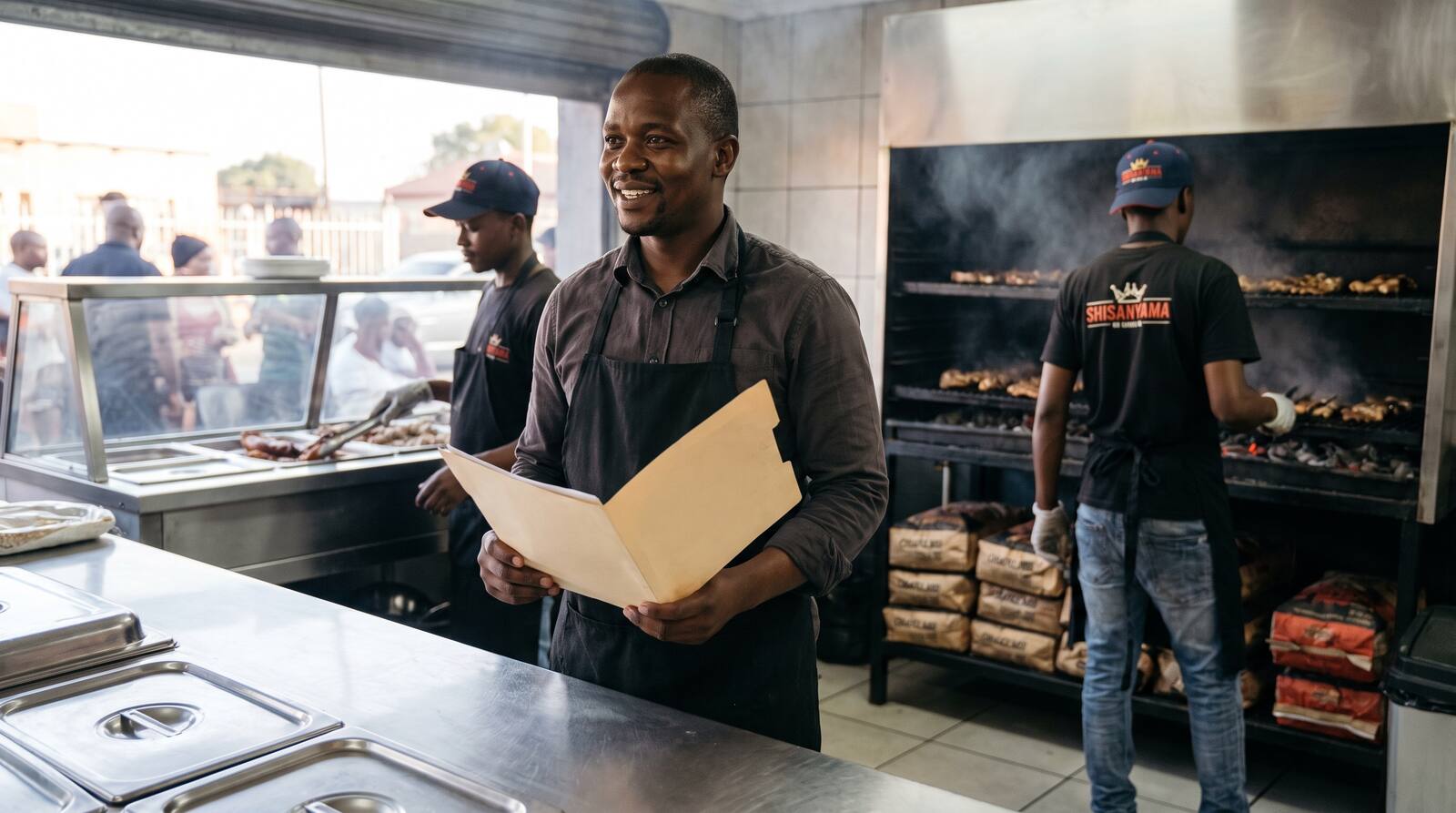
What a Shisanyama Business Plan Must Cover
A shisanyama business plan needs to show how you will buy meat, where you will braai and serve, how many customers you expect, what your costs are, and how you will stay legal with health, fire and liquor rules. Funders and landlords want to see real numbers, not just a love for braai meat. This article walks you through every section your plan needs and the order in which to tackle them.
Register Your Business First
Before anyone takes your plan seriously, you need a registered company. Go to CIPC and register a private company. You will need a company registration number, a share certificate and a CIPC disclosure certificate. SARS registration comes next, so you can get a tax clearance certificate.
KAGO can handle the registration for you with the Registration Basic at R995, which covers CIPC registration and the basic documents you need to start trading.
Your Shisanyama Location and Setup
Your plan must describe the site in detail. Is it a container, a rented stand, a backyard or a proper commercial property? Include the address, the size, the lease agreement if you have one, and what infrastructure you need: water, electricity, ventilation, seating, a braai area, toilets and parking.
Township municipalities have bylaws about open fires, smoke and noise. Your plan should show that you have checked these and that your setup will comply. If you need a zoning letter or consent use approval, say so and show where you are in that process.
Menu and Pricing
List your menu clearly: beef, wors, chicken, lamb, chops, pap, chakalaka, salads and drinks. Show your cost per portion and your selling price. Funders want to see your gross profit margin on each item.
For example, if you sell a plate of wors and pap for R35 and your ingredient cost is R18, your gross profit is R17 per plate. Multiply that by the number of plates you expect to sell per day and you have a daily revenue figure. Do this for every item on your menu.
Equipment and Start-Up Costs
Your plan needs a list of equipment and what each item costs. Typical shisanyama equipment includes:
- Braai stands or commercial grills
- Meat display fridge
- Cold drink fridge
- Prep tables and cutting boards
- Pots for pap and chakalaka
- Utensils, plates and packaging
- Tables and chairs for seating
- Sound system if you want music
- Fire extinguisher and first aid kit
- Signage and branding
Put a price next to each item and total it. This becomes your start-up cost section. Be honest about what you already own and what you still need to buy.
Licences and Compliance
A shisanyama needs several licences before it can trade legally:
- Business licence from your local municipality
- Health and food safety certificate from the environmental health department
- Fire safety compliance, especially for open flame cooking
- Liquor licence if you plan to sell alcohol, which is a separate application through the provincial liquor board
- Music licence with SAMRO if you play copyrighted music
- COIDA letter of good standing with the Compensation Fund if you have employees
Your plan should list each licence, the responsible authority and the status of each application. If you have not applied yet, say so and include the application cost in your start-up budget.
Staffing
How many people will you employ? A typical shisanyama starts with a braaier, a prep person, a cashier and a cleaner. Show their wages, UIF contributions and shifts. If you are the braaier, state that clearly and show what you will pay yourself.
Remember that UIF registration with the Department of Employment and Labour is compulsory once you employ someone. Your plan should show that you understand this obligation.
Financial Plan
This is the section most funders read first. You need:
- Start-up costs total
- Monthly running costs: rent, electricity, water, wages, stock, transport, marketing
- Projected monthly revenue based on realistic customer numbers
- Break-even point: the month when revenue covers all costs
- Cash flow projection for twelve months
Be realistic about customer numbers. A new shisanyama does not sell out every day. Show slow weeks and busy weeks. Funders respect a plan that accounts for quiet periods.
Funding Readiness
No business plan guarantees funding. The funder always decides. But a plan that shows real costs, real compliance and realistic sales makes you far more likely to be taken seriously by SEFA, NYDA, a bank or a private investor.
If you want a complete plan that covers everything above, KAGO's Complete Business Plan at R3,495 includes the written plan and the financial projections in one pack. We make you funding-ready, but we cannot promise you will get the money.
Marketing and Customers
How will people know about your shisanyama? Word of mouth is powerful in townships, but you still need a plan. Include social media pages, flyers at local taxi ranks, a WhatsApp group for regulars, and partnerships with stokvels or local sports teams.
Show how many customers you expect in week one, month one and month six. If you expect to grow from 20 plates a day to 80 plates a day, explain what drives that growth.
Common Mistakes to Avoid
- Underestimating stock costs
- Forgetting electricity and gas as monthly costs
- Not budgeting for spoilage and waste
- Skipping the liquor licence and trading illegally
- Using your personal bank account instead of a business account
- Keeping no written record of daily sales
Each of these can sink a shisanyama in the first six months. Your business plan should address every one of them.
Final Steps Before You Open
- Register the company with CIPC
- Get SARS tax clearance
- Secure your site and sign a lease or get written permission
- Apply for municipal business and health permits
- Apply for a liquor licence if needed
- Buy equipment and stock
- Open a business bank account
- Start trading and record every sale
A shisanyama is a real business. Treat it like one from day one and your plan will do the work for you when you approach a funder, a landlord or a supplier.
Questions people also ask
Do I need a liquor licence to start a shisanyama?
Only if you plan to sell alcohol. You can start with food only and apply for a liquor licence later, but selling alcohol without one risks fines and closure. The application goes through your provincial liquor board and takes time, so start it early if you need it.
How much does it cost to start a shisanyama?
It depends on your setup. A basic container or stand shisanyama needs less capital than a sit-down venue with seating and a sound system. Your business plan should itemise every cost, from equipment and stock to permits and the first few months of rent.
Can I get funding for a shisanyama from NYDA or SEFA?
Both agencies fund township businesses, but they require a registered company, a complete business plan and financial projections. KAGO can make you funding-ready, but the funder always makes the final decision.
Fixed prices, no hourly billing
Let KAGO build it for you.
Business plans, financial plans, company registration, logos and tender packs, at a menu price, in days. We make your business funding-ready. The funder always decides.